Why Barbell Club Might Be the Missing Piece in Your Training

Nate Hemphill • April 9, 2026

At CrossFit Broken Chains, Barbell Club isn’t just another program—it’s been a cornerstone of who we are for over 13 years.


Twice a year, we carve out dedicated time to focus on one thing: becoming better, more confident, and more powerful Olympic weightlifters.


If you’ve ever felt like your snatch or clean & jerk is holding you back… this is for you.

What Is Barbell Club?

Barbell Club is a 6-week specialty program designed to help athletes improve their Olympic lifting technique, strength, and confidence.

Program Details:
  • Start Date: April 25
  • Duration: 6 weeks
  • Schedule: Saturdays, 9:45 AM – 11:15 AM (90 minutes)
  • Final Week: Mock Olympic Weightlifting Meet (May 30)
Each session is focused, intentional, and built to help you move better under the barbell.

We finish the cycle with a true competition-style max-out session, where athletes:
  • Complete an InBody scan
  • Declare opening lifts
  • Take 3 attempts at snatch and clean & jerk
Lift in front of their peers in a supportive, high-energy environment

Why Barbell Club Works 

1. Master the Most Technical Movements in CrossFit

The snatch and clean & jerk are like a golf swing—small adjustments make a huge difference.


In regular classes, you might get a few reps under fatigue.


In Barbell Club, you get:

  • Repetition
  • Coaching
  • Precision

This is where technique is built—not rushed.

2. Train Without Fatigue

In CrossFit classes, you’re often lifting while tired—after cardio, gymnastics, or high-intensity work.


Barbell Club flips that.


You’ll train:

  • Fresh
  • Focused
  • With intention

That means better movement patterns, better positions, and better results.

3. Break Through Plateaus

If you’ve ever thought:

  • “I can’t get under the bar”
  • “I’m stuck power cleaning everything”
  • “My overhead position feels unstable”
  • You’re not alone—and you’re not stuck.


We break lifts down into components:

  • Pulling from the floor
  • Speed under the bar
  • Catching in the squat
  • Standing up strong

Then we rebuild them—correctly.

4. Get Expert Coaching (and Immediate Feedback)

Our coaching staff brings years of experience, including USA Weightlifting certifications and CrossFit specialty training.


Inside Barbell Club, you’ll get:

  • Real-time corrections
  • Individualized feedback
  • Slow-motion video analysis
  • Targeted drills for your specific weaknesses

This level of attention is hard to replicate in a standard class setting.

5. Build Strength, Mobility, and Confidence

Olympic lifting demands:

  • Strength
  • Speed
  • Coordination
  • Mobility
  • Timing


Barbell Club develops all of it.


Athletes often see improvements not just in lifting—but in:

  • Squats
  • Overall strength
  • Body awareness
  • Confidence under heavy loads

6. Train With a Committed Team

This program is capped at 10 athletes.


That’s intentional.


You’ll be surrounded by a small, focused group of athletes who:

  • Show up consistently
  • Push each other
  • Hold each other accountable

The environment matters—and this one is built for growth.

7. Test Yourself on the Platform

There’s nothing like stepping onto the platform and going for a lift you’ve been working toward for six weeks.


Our final session simulates a real Olympic weightlifting meet:

  • Structured attempts
  • Crowd energy
  • Personal best opportunities

It’s challenging, rewarding, and unforgettable.

Who Is This For?

  • Beginners who want to learn the lifts the right way
  • Intermediate athletes stuck in bad habits or plateaus
  • Advanced athletes looking to refine technique and maximize performance

If you’re doing CrossFit—you will benefit from this.

Investment in Your Progress


This isn’t just another class—it’s a focused investment in your development as an athlete.

Final Thought

If CrossFit builds general fitness, Barbell Club sharpens your edge.


You’ll move better. Lift heavier. Feel more confident. And walk away with skills that carry over into everything you do in the gym.


Spots are limited—and they will fill.


Let’s get to work.
By Nate Hemphill May 20, 2026
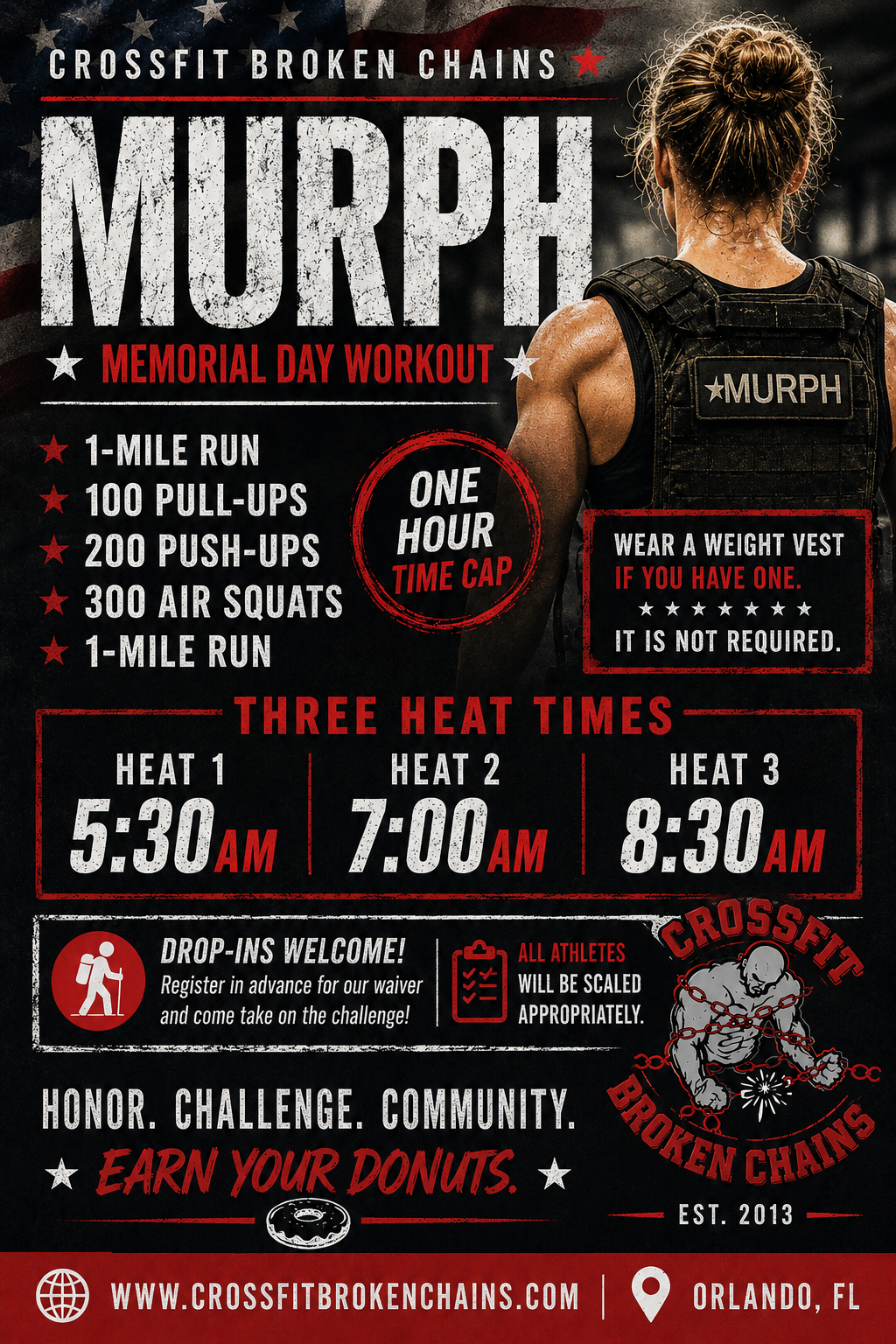
Every year on Memorial Day, CrossFit gyms around the world take on one of the most well-known Hero workouts in CrossFit: Murph. The workout is simple on paper: 1-mile run 100 pull-ups 200 push-ups 300 air squats 1-mile run At CrossFit Broken Chains, we’ll be taking on Murph this Monday with three heat times: 5:30 a.m. 7:00 a.m. 8:30 a.m. There will be a one-hour time cap , so come prepared and ready to go. First Things First: What Counts as RX? This is probably the most common question—and honestly, it’s the least important one. The better question is: What version of this workout allows me to honor it, challenge myself, and still train smart? The original version says that if you have a weight vest, you can wear it—but it is not required. Some athletes will wear a vest. Some will not. Some will partition the reps. Some will not. Some will scale the volume. Some will partner up. All of that is fine. The goal is not to destroy yourself. The goal is to step into a challenging workout, give an honest effort, and walk away better—not injured, not overheated, and not completely wrecked. Know Your Options One of the most effective ways to approach Murph is by partitioning the reps: 1-mile run 20 rounds of: 5 pull-ups 10 push-ups 15 air squats 1-mile run This keeps the reps manageable and allows you to keep moving. A more advanced and significantly more difficult version is unpartitioned: 1-mile run 100 pull-ups 200 push-ups 300 air squats 1-mile run This version requires a high level of strength endurance and rest management. It is not for everyone. If this is your first time—or if you know your current capacity isn’t quite there yet—scaling is absolutely appropriate. A half version could look like: 800-meter run 50 pull-ups (or ring rows/banded) 100 push-ups 150 air squats 800-meter run Another great option is to partner up. Run together, then split the reps however you need to. This allows you to keep moving while managing fatigue. Don’t Walk Into This Blind If you’ve been training consistently—especially on Mondays—you already have a good sense of what this workout is going to feel like. Use that information. If push-ups tend to fall apart quickly, scale early. If pull-ups aren’t there yet, modify them. If running in the heat is a challenge, pace it appropriately. Murph is not the day to pretend you’re a different athlete than you’ve been in training. Be honest about where you are. Then go to work. Prepare Before Monday The low-hanging fruit matters here. Don’t start Memorial Day weekend by partying too early and then expect your body to perform at a high level on Monday morning. Hydrate. Eat well. Sleep. Avoid alcohol leading into the workout if you want to feel good and perform well. Sleep is one of the most overlooked performance tools we have. If you can, aim to get at least 8 hours of quality sleep the night before. That means getting to bed early and giving your body the opportunity to recover. Showing up well-rested will make a noticeable difference in how you feel, how you pace, and how you perform. Don’t let a late night ruin a great workout. Also, don’t come in on an empty stomach. Have something simple and digestible about 1–2 hours before the workout: Protein shake Banana Eggs Peanut butter A simple Zone-style meal You want fuel in the tank. Hydration is just as important—especially in the Florida heat. During longer efforts like this, athletes can lose 1–2 liters of sweat per hour, depending on conditions and intensity. That’s significant. A good general guideline is to consume fluids regularly leading up to the workout and consider adding electrolytes or sodium to help maintain performance and prevent cramping. Final Thought Murph is hard. It’s supposed to be hard. But hard does not mean reckless. This workout is about effort, discipline, and respect—for the workout, for yourself, and for the people around you. Choose the right version. Show up prepared. Push yourself—but don’t be foolish. At CrossFit Broken Chains, we’re going to show up, suffer a little together, cheer each other on, and get through it as a community. And yes… we’ll earn those donuts afterward.  Easy Day. See you at the box! 💪
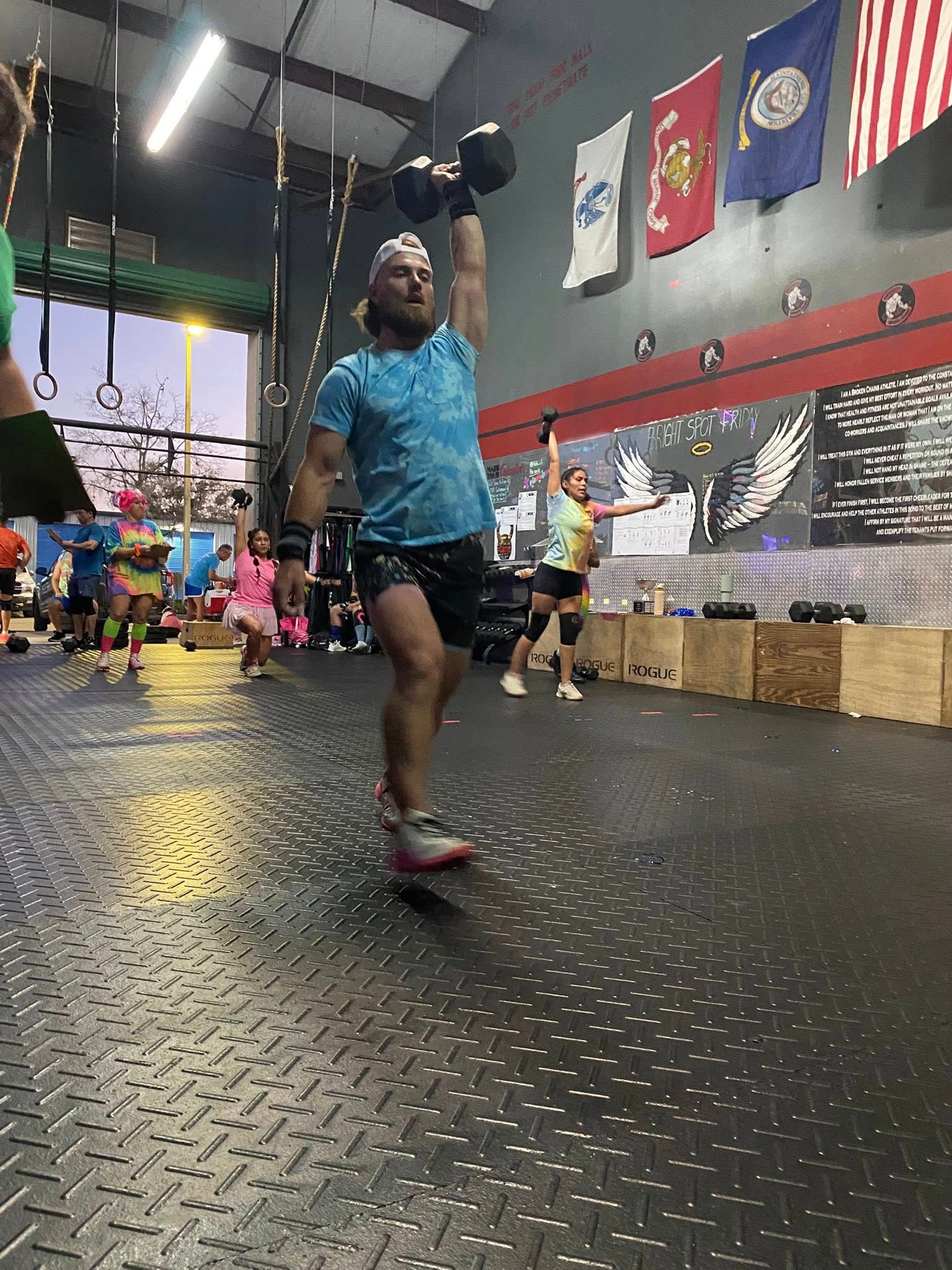
A person in a blue shirt performs a dumbbell overhead press in a gym with American and military flags on the wall.
By Nate Hemphill March 20, 2026
I’ve been doing the CrossFit Open since the very first one back in 2011. Every year, I show up, I push hard, and I test myself—just like all of you. But over time, my perspective on the Open has changed. It’s no longer about feeling like there’s something forcing me to compete or prove something. Instead, I look at it the same way I would for any everyday CrossFitter: What can I learn from this—and how do I use it to get better? Because that’s what the Open really is. It’s not just a competition. It’s feedback.
By Coach Nate Hemphill - CCFT-L3 March 10, 2026
Every year when the CrossFit Games Open rolls around, something special happens inside a CrossFit gym. You can feel it in the air. The nerves are a little higher. The cheering is a little louder. Athletes push a little harder than they normally would on an everyday workout. Something about the Open brings out a level of effort and excitement that is hard to explain unless you’ve experienced it.  And after participating in every single Open workout since the beginning, I can confidently say this: there is nothing else like it in the entire fitness world.